University College Cork and Cork & Kerry ETBs Launch Groundbreaking BSc (Hons) in Occupational Therapy
Posted: 28 March, 2025
New Tertiary Degree Programme Offers Unique Pathway from Further Education to University
University College Cork (UCC) and Cork & Kerry Education and Training Boards (ETBs) are delighted to announce the launch of an innovative new tertiary degree programme, the BSc (Hons) Occupational Therapy. This exciting collaboration provides students with a unique pathway, beginning in Further Education and progressing directly to UCC upon meeting entry requirements.
A Transformative Approach to Occupational Therapy Education
Occupational therapy is a dynamic and rewarding profession dedicated to helping individuals overcome physical, mental, or social barriers to living fulfilling lives. This five-year programme integrates a first-year learning at Cork College of Further Education, Morrison’s Island Campus, and Kerry College, Denny Street Campus, with a four-year degree at UCC, ensuring a seamless transition for students.
The course embodies a holistic development approach where the emphasis is on personal and professional growth opportunities woven throughout academic and practical modules. Innovative learning methods such as task-based learning (TBL), fostering critical thinking, teamwork, and self-directed study are integrated into all years of the programme. Throughout the five-year degree programme, students delve into paediatric, adult, and geriatric care, as well as physical and mental health. Fully accredited by the World Federation of Occupational Therapists and the Association of Occupational Therapists of Ireland ensures international employability for its graduates.
This innovative programme seeks passionate individuals committed to making a difference in healthcare and includes embedded awards to certify students’ progress:
- Year 1 Completion: QQI Level 5 Certificate in Health Service Skills
- Years 2-5 Completion: BSc (Hons) Occupational Therapy from UCC
For entry and progression requirements along with the next steps please go to BSc (Hons) Occupational Therapy | Courses | National Tertiary Office
A New Era in Allied Health Education
For More Information
Prospective students are encouraged to contact:
Tertiary Managers- Kathy Bradley and Gobnait Burke
Email: feather@corketb.ie or nto@corketb.ie
ATU and CMETB launch Tertiary Degree Programme in Social Care Practice at Cavan Institute
ATU, in partnership with Cavan and Monaghan Education and Training Board (CMETB) recently launched a new Tertiary Education degree at Cavan Institute, the BA (Hons) in Social Care Practice. The programme which already exists at ATU Sligo’s campus, now provides a one year plus three-year study opportunity for learners interested in studying year one of the honours degree programme at Cavan Institute.
Following completion of year one of the programme, learners will then progress to year two of the honour’s degree programme at ATU Sligo. This innovative partnership between ATU and Cavan Institute is the latest addition to the tertiary education programme offering at ATU and is a significant step forward for the social care sector and regional development.
This partnership provides a flexible and accessible pathway to a university degree for students in the Cavan region and beyond. Students can now progress from further education (FE) to higher education (HE) within their local community, reducing barriers like travel and accommodation costs.
Additionally, the programme aims to meet current industry demand for social care practitioners. The social care sector in Ireland is facing a growing demand for qualified professionals due to an aging population, increased mental health needs, and social service expansion.
To find out more about this programme and how to apply to join, visit www.cavaninstitute.ie
TUS and TETB launch Tertiary Degree Programme in Digital Arts (Common Entry)
This programme aims to offer students the opportunity to complete year one of a common entry degree in Digital Arts, with Tipperary ETB, before having a guaranteed progression route to years two to four with TUS Midwest (Clonmel Campus).
Year one of this four-year degree programme will provide students with the opportunity to complete modules that will introduce them to the concepts, knowledge and skills associated with digital animation, game art and design and visual effects.
Students will have access to industry standard equipment, software applications and subject matter experts to guide them, so as to ensure they can make an informed decision on their preferred year 2 programme.
Having successfully completed year one of the degree, students will progress to year two of their chosen degree in one of the following:
• Bachelor of Science (Honours) in Digital Animation
• Bachelor of Science (Honours) in Game Art and Design
• Bachelor of Science (Honours) in Visual Effects for Film, TV, and Animation
For More Information prospective students and stakeholders are encouraged to contact:
Tertiary Managers- Jenny Whelan & Sarah O’Toole
For more information, please contact the Tertiary Managers at admissions@tipperaryetb.ie
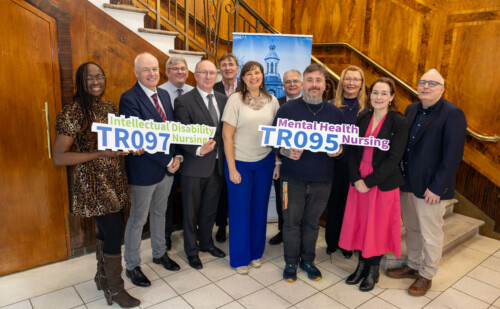
SETU and WWETB launch Tertiary Degree Programme in Bachelor of Science (Hons) in Intellectual Disability Nursing
SETU, Cork Road, Waterford and Waterford College of Further Education (WCFE), part of Waterford and Wexford education and Training Board (WWETB), are proposing to offer the SETU Bachelor of Science (Hons) in Intellectual Disability Nursing, as part of the new Unified Tertiary System
The collaboration between SETU and WWETB, where the BSc. (Hons) in Intellectual Disability Nursing will be made available to FET learners in WCFE as part of the tertiary system, will offer tertiary learners the opportunity to partake in a 1+4 degree programme, where they will complete the first year as a pre-entry route, in Waterford College of Further Education, followed by Years 1,2, 3 and 4 of the honours degree at SETU’s Waterford campus in the Department of Nursing.
Intellectual disability nurses work in environments such as in people’s homes, education and community settings, residential and respite services, schools and health centres. Intellectual disability nurses can work with children, adolescents, adults and their families. Intellectual disability nurses work as part of a multidisciplinary team in the community.
Graduates may practice as a Registered Intellectual Disability Nurse within the Irish healthcare sector and voluntary services. Universally Irish nurses are highly regarded by other countries thus enhancing work opportunities.
Following qualification, it is possible to specialise in a number of areas within intellectual disability nursing i.e. challenging behaviour, multiple and complex disabilities. Alternatively, graduates may choose to pursue advanced studies in nursing education or nursing management.
The BSc. (hons) in Intellectual Disability Nursing at Level 8 offered as a tertiary programme between SETU and WWETB, will provide learners with a breadth of transferable health competencies.
For More Information prospective students and stakeholders are encouraged to contact:
Tertiary Managers- Alan O’Gorman & Sarah Sartori
For more information, please contact the Tertiary Managers at nto@wwetb.ie